Wednesday, June 25, 2014

THE INCREDIBLE ARCHITECTURE OF INDONESIA’S TANA TORAJA

Source
Sulawesi is a large island, extraordinarily contorted in shape, lying between Kalimantan and the Maluku Island group. Tana Toraja is located in the South Sulawesi Province and the traditional culture of the Torajans rivals any in the archipelago, making this area one of the most popular tourist destinations in Indonesia.

Source

Source

Source
Believing that their forefathers descended from heaven in a boat some twenty generations ago, the Torajans have a unique Christian animist culture. Their ancestral worshiping includes elaborate death and after life ceremonies, which are essentially great feasts. A strict social hierarchy is followed in the villages and an important wedding or funeral can take days to perform. Water buffalo and pigs are sacrificed in numbers appropriate to social rank, and the deceased's remains are placed in a coffin and interred in caves hollowed out in high cliffs. The mouth of the cave is guarded by lifelike statues, called Tau Tau, who look out from a balcony near the burial caves, watching over the families and friends they have left behind.


Source
Tongkonan, the family houses, are built on stilts with the roof rearing up at either end, representing the prows of the first ship to arrive in the area with the Torajan ancestors. The houses all face north and some say that this is because it was from the north that the ancestors of the Toraja came. Others however will say that the north is regarded as the realm of the gods, on the compass of life.


Source  

Source
A large tongkonan can take a crew of ten about three months to build and another month to carve and paint the outside walls. Bamboo scaffolding is erected for the duration of the construction phase. The distinctive curved roof shape is obtained through a series of vertical hanging spars supporting upwardly angled beams. A vertical free-standing pole supports that portion of the ridge pole extending beyond the ridge. In larger Tana Toraja villages, houses are arranged in a row, side by side, with their roofs on a north-south alignment with the front gable facing north. Opposite each house is the family's rice barn, or alang customarily a symbol of family wealth, and together they form a second row of parallel buildings.

Source

Source

Friday, June 6, 2014

MORE UNIQUE BATHTUBS

1. The Madera Wood Bathtub


This free-standing wood-carved bathtubs brings sculptural beauty to your bathroom. The laminated layers of wood create a pallet of textures that makes each bathtub unique. The Madera Bathtub is polished and oiled for a high-quality finish. This bathtub is available from WS Bath Collections in brilliant woods like larch, beech, mahogany, cedar, cherry, walnut, wenge and teak.

2. The Hilo Bathtub
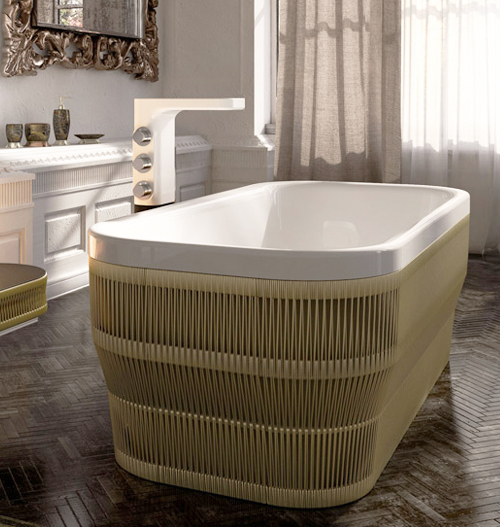
glass-idromassagio-freestanding-acrylic-bathtub-hilo-1.jpg

This unique acrylic freestanding bathtub by Glass Idromassagio is majectic and powerful, yet elegant. The textural linear outer casing is the most visually interesting feature and makes it stand apart from other freestanding tubs.
3. The Wood Finish Bathtub
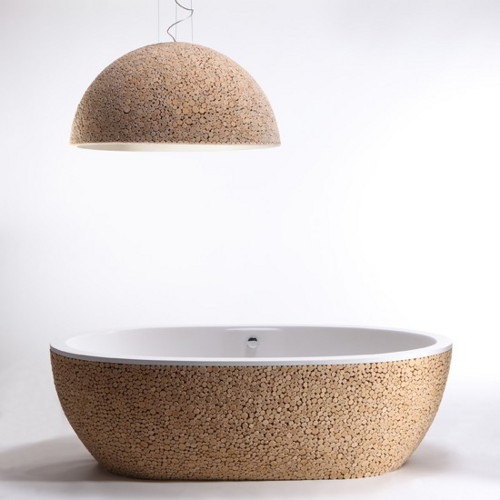
wood-finish-bathtub-bleu-nature-baignoire-stone-pixel-1.jpg

This wood finish bathtub by Bleu Nature is an artful combination of man meets nature; organic elements and modern finishes, mixing in sweet harmony. The Baignoire Stone Pixel tub stands out with its natural driftwood adornments, arranged in an earthy motif to balance the ultra-contemporary lacquered metal, all set on a bold, broad bathtub shaped to suit any space. The collection also includes a matching light fixture, featuring the same silhouette and natural facade wrapping a clean, white interior.

4. Manuel Dreesmann Bathtubs

Gone are the days of the utilitarian, boring bathroom – welcome the new wave of amazing bathtubs, from German designer Manuel Dreesmann and Swiss bathroom brand Bagno Sasso. The Ocean Wave and the Ocean Wing bathtubs are made of Corian, notable for their wonderful organic look and feel. Their sculptural silhouettes, featuring "waves" and "wings" - hence their names - boast a free-form aesthetic that seems to have a mind of its own, perfect for placement in the center of the room.

5. Splinter Works 'Vessal' Bathtubs


The 'Vessal' is mimics both a hammock and a bathtub for the ultimate relaxing experience. That's just what UK-based design group Splinter Works is aiming for with its latest slick elevated bathtub.

6. Stone Forest Bathtubs


If you wish a extraordinary plus unique bathtub, then you should surely choose to buy one from Stone Forest, where the planners can transform stone into astonishing bathtubs.

7. grinERA Bathtubs


grinERA produces solid wood bathtubs and hand wash basins from 100% wood. Their products can be customized from many different kinds of wood.

8. The Swaybath


Drawing inspiration from childbirth and the calmness and security within the womb, British designer Ben Mazur has come up with a unique bathtub called “Swaybath,” which is filled from the drenching showerhead above the tub, and emptied through a valve in the bottom into a drain below. The calming, gentle movement of the water and subtle swaying, turning motion combined with the embrace of the silicone tub as it molds around you to create a placental hideaway from the outside world.

8. The Egg Bathtub


Unico mixed a freestanding oval bathtub with some open storage space.

9. The Origami Bathtub


Stucco presents the Origami: a bathtub combined with four base units that is elegant, versatile and unique.

10.  The Carbon Fibre Bathtub


This incredible carbon fiber bathtub by Corcel seems to play with senses and to completely reevaluate one’s idea of taking a bath the calm way. Because what it inspires is speed in a straightforward way. Its appearance is unique, with black stripes that contribute to an original aerodynamic shape.

For more see:
20 MORE UNIQUE BATHTUBS

THE RISE AND FALL OF SOUTH AFRICA'S TALLEST SKYSCRAPER

If you start to read about a place like Ponte Tower, wherever you live will not seem that bad...

The Ponte Tower building in Johannesburg. Photo © flickr.
Peeking into Ponte Tower on a flying tour of Johannesburg. Photo © FlyJozi.
Ponte Tower is a 54-storey-high cylinder-shaped building that has been hovering over the skyline of Johannesburg since 1975. The sign on the top of the building is the largest sigh in the Southern hemisphere.

Looking up from the center of the building. Photo © David Southwood.

The inside core of Ponte Tower, looking up at the hallway windows. Photo © RabbitingOn.
Back in the day, this extraordinary building designed by Manfred Hermer, was one of the most coveted addresses in the city. In the midst of South Africa's Apartheid era, Ponte Tower became the emblem of the country's racial segregation. Laws requiring kitchens and bathrooms to have a window, therefore he decided to leave an open, 32,000 square foot inner core, which let light into apartments from both sides. Only wealthy white families were allowed to live in the outward-facing apartments, while the inner apartments were reserved for their black servants, who lived in partial darkness. They put retail stores at the bottom and had plans to include an indoor ski slope on the core floor. They built saunas and chrome bars in all the penthouses.

A glimmer of sun shining through the core of the building. Photo © Anderson KA.

After the fall of Apartheid the surrounding neighborhood, once an upscale area of the city, became consumed by crime. By the mid '90s, Hillbrow's murder and rape rates were worse than almost any place in the world. Despite the expansive views from every unit, the building became known for rats, guns, drugs and violence.

The Ponte Tower building in Johannesburg. Photo © flickr.
Many downtown building owners gave up on their properties when they weren't able to collect rent from tenants, or couldn't control the crowds of people forcing their way into each apartment. Some apartment complexes were "hijacked" by gangs who blocked owners from entering and forced tenants to pay them instead.

Garbage started to pile up in the courtyard that covers the first five floors of the building. In the late 90s, it was suggested that the structure be turned into a maximum security prison, but this idea was later discarded. At its lowest point, Ponte Tower became became known as "suicide central" because people committed suicide by jumping off from the center of the building.


The debris in the courtyard. Photo © StoryOfBing.

Today, the Ponte Tower is still the tallest residential skyscraper in Africa and remarkably, people are still willing to call it their home. However, there is hope for residents. In the past few years major improvements has been made to ensure the safety of the residents. In May 2007 Ponte changed ownership and a re-development project "New Ponte" was put in motion. Current resident, Manny de Costa states that even though Hillbrow is still considered one of the most dangerous neighborhoods in the world, the building itself is safe.

Currently a few renovated apartments called "Global Fusion" is up for sale. Developers are selling all of the units furnished, in styles that range from "Future Slick" – all red, black, and chrome minimalist – to "Glam Rock," with velvet, '60s-patterned furniture. The apartments sell from $80,000 to $150,000. Other plans for the building includes building an indoor climbing center, a huge child-care center, restaurants, spas and even a gym.

The view from one of the newly renovated apartments. Photo © StoryOfBing.

The interior of one of the newly renovated apartments. Photo © StoryOfBing.

Sources:
www.messynessychic.com
www.csmonitor.com

Thursday, June 27, 2013

MOROCCO'S INCREDIBLE AIT BENHADDOU

Image source
Aït Benhaddou – a striking example of the architecture of southern Morocco – is a fortified mud-brick also called a ksar, on the edge of the High Atlas Mountains in Morocco. It is situated in Souss-Massa-Drâa on a hill along the Ounila River. Aït Benhaddou has been a UNESCO World Heritage Site since 1987 and several films, such as Lawrence of Arabia, The Mummy, Gladiator, Alexander, Babel, Kingdom of Heaven and Prince of Persia have been shot there as well as some scenes from Game of Thrones. Today, although only inhabited by around half-a-dozen families, visitors are attracted by the number and variety of its kasbahs (mud-built structures), some of which are thought to date back to the sixteenth century.

The Ksar has a high defensive earthen wall with angle towers and baffle gate, surrounding a remarkable ensemble of dwellings, with narrow alleys climbing the hillside. There is also communal areas that include a mosque, a public square, a loft and two cemeteries. Some of the homes of the wealthy traders are grand multi-storey structures with quite elaborate decorative motifs and angular corner towers resembling small castles. On the top of the hill there is large fortified granary, or agadir.

Historically, traders carrying spices, slaves, and gold on the Sahara Trade Route passed by Aït Benhaddou and its Ksours on their way to Timbuktu or the Western Sahara. Today, the old trade route is no longer in use and the Kasbahs have turned into a popular tourist destination. The village  of Aït Benhaddou is divided in two parts. The modern part is filled with tourist shops and parking spaces. Upon crossing the Oued (dry riverbed), you will enter into the Ksar, the real highlight.

The architectural style of the buildings are well preserved because the earthen structures were build to adapt to the climatic conditions of the environment, however it does need regular maintenance since its abandonment by most of its inhabitants (10 families still live inside the ksar). Today, under the protection of CERKAS (Centre for the conservation and rehabilitation of the architectural heritage of atlas and sub-atlas zones) the site is able to maintain its authenticity. Various workshops are held where local local people are taught how to maintain the site and various management committees have been established.

Image source
Add caption
Image source
Image source
Image source
Image source
Image source
Image source
Add caption

Friday, April 12, 2013

UNUSUAL HOTEL #6: CAMBODIA’S INCREDIBLE 4- RIVERS FLOATING LODGE

Source
The 4-Rivers Floating Lodge is a boutique resort in Cambodia, situated in Tatai, next to the Thai border and halfway between Bangkok and Phnom Penh. It is a place of unspoilt virgin forest, rare orchids and fragrant frangipani. The startling colours and calls of birds of paradise, secretive jungle creatures and perfumed air of peace and solitude is as close to Eden as you can get.

Rich in natural beauty, Tatai River is your highway to the wonders of the Cardamoms and Southeast Asia’s largest coastal mangrove. According to the Wildlife Alliance, World Wildlife Fund and other concerned charities, this remarkable rainforest ecoregion is considered to harbour more than 100 mammal species including numerous endangered animals such as the clouded leopard, pileated gibbon and Malaysian sun bear. The lush forested slopes of the Cardamoms are a perfect hiding place for the rare Javan rhinoceros, Indochinese tiger and Asian elephant.

The resort aims to spoil their guests endlessly with so many activities and luxuries. Guests can embark on trekking trips into the jungle and will have many opportunities to explore the untouched tropical rainforests. Kayak trips down the river with experienced guides will lead guests through the mangrove waterways that reach back into the jungle. Guests can also try their hand at fishing. Back at the resort guest can indulge with a hydro massage, go on a romantic sunset cruise, take a dip in the river and lounge at the restaurant, to name a few. 


Source
Source
Source
Source
Source
Source
Source
Source

POPEYE'S REAL-LIFE VILLAGE

Source
Tucked away in the small European country of Malta, is a place you’d probably never expect to find in the real world – Popeye’s Village. The village, located in Anchor Bay, also known as Sweethaven village, was the actual set built for the 1980 musical film Popeye, produced by Paramount Pictures and Walt Disney Productions and starring Robin Williams. Today, its open to the public as a theme park and is popular family vacation spot and one of Malta’s major tourist attractions.

The construction of the film set started in June 1979. A construction crew of 165 working over seven months was needed to build the village, which consists of nineteen authentic wooden buildings. Hundreds of logs and several thousand wooden planks were imported from the Netherlands, while wood shingles used in the construction of the roof tops were imported from Canada. Eight tons of nails and two thousand gallons of paint were also used in construction.In addition, a 200–250 foot breakwater was built around Anchor Bay's mouth to protect the set from high seas during the shooting.

Thing you can expect when visiting the village are shows, rides, boat ride and museums, as well as play houses where children can climb and explore the village. Children may also get to meet the main characters from the show such as Popeye, Olive Oyl, Bluto and Wimpy. Visitors can enjoy a twenty-minute boat trip around Anchor Bay where one can photograph the scenery.
source

Source
Source
Source
Source
Source
Source